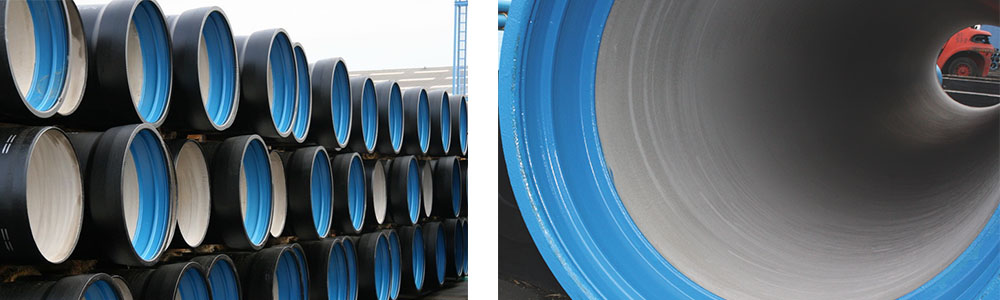
Interior Lining
to prevent chemical attack of water on the pipe
The interior lining is the key to preventing chemical attack of water on the pipe. It must also be able to withstand abrasion from suspended particles. And, very importantly, its roughness must be low to offer little resistance to the passage of water, minimizing pressure losses.
Our pipes are internally lined with a compact and resistant layer of cement mortar, according to ISO 2531 and EN 545 standards, applied in accordance with ISO 4179.
At CONSTRUTEC, we are committed to the integrity of the quality of the cement lining of our pipes to ensure their optimal handling and transport to any part of the world.
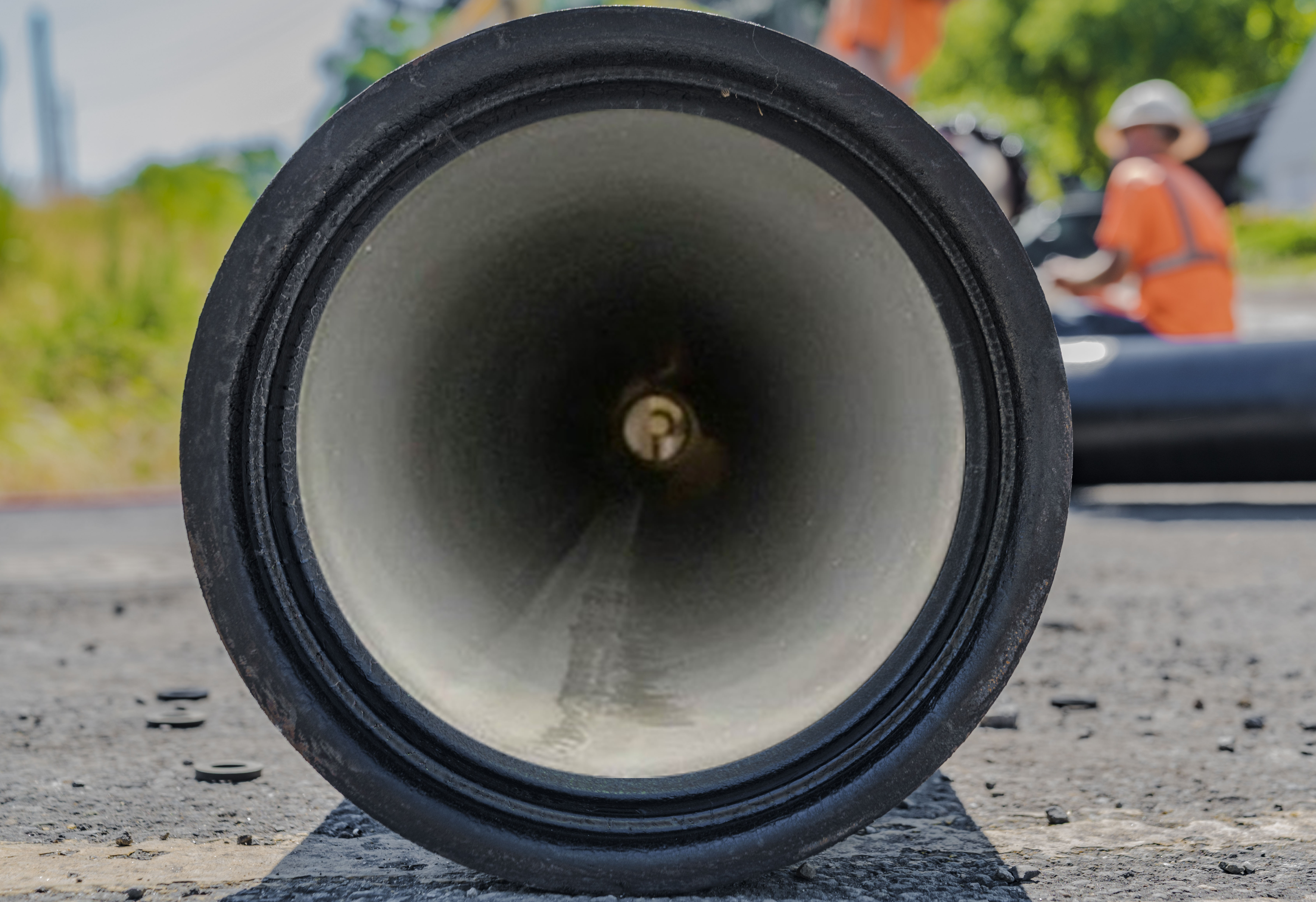
Types of Interior Linings
Water Supply / Drinking Water
- Sulfate Resistant Cement (SRC)
- Blast Furnace Slag Cement (BFC)
- Ordinary Portland Cement (OPC), consonant with ISO 2531 and EN 545 standards and applied according to ISO 4179
Sanitation / Sewerage
- High Alumina Cement HAC consonant with ISO 7186 and EN 598 standards
- Polyurethane according to EN 15655 standard
Technical Specifications of the Internal Coatings
Chemical Alliance
One of the surprising advantages of the internal mortar lining is that, in addition to being an evident physical protection, it also constitutes chemical protection.
Head Loss
The head loss in the pipeline is reduced to a minimum. Furthermore, unlike other materials, there is no degradation over time. On the other hand, it is completely immune to biological attack and exhibits excellent behavior under thermal stress.
Roughness
The internal mortar lining is applied in the factory at a centrifugation speed with a ‘G’ value greater than 60 G. As it is cured in the plant under controlled conditions, its low roughness and resistance to impacts and abrasion are ensured. The resulting roughness is extremely low compared to any other material.
| Absolute roughness | C (Hazen-Williams) | n (Manning) |
|---|---|---|
| ≈ 0,030 mm | ≈ 140 | ≈ 0,0088 |